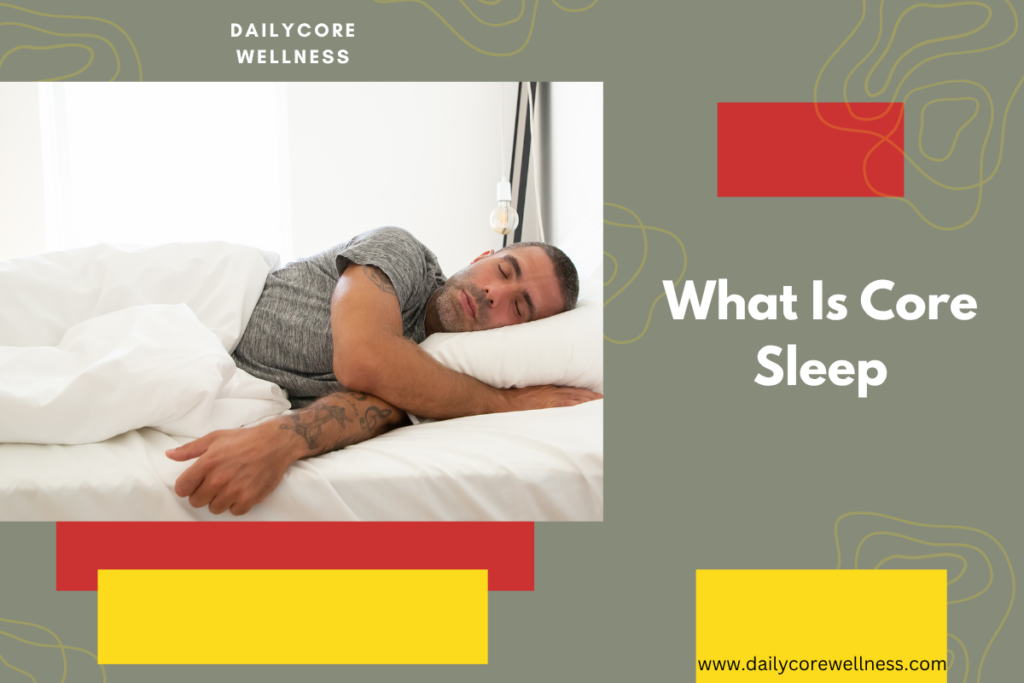
Core sleep is a term commonly used to describe the most essential part of your nightly sleep. It generally refers to the sleep your body needs to support important physical and mental functions, although “core sleep” is not an official sleep stage used in clinical sleep medicine. Instead, sleep is formally divided into non-REM and REM stages, with non-REM including lighter sleep and deeper slow-wave sleep.
Understanding what is core sleep can help you make sense of sleep trackers, wearable devices, and discussions about sleep quality. Some devices use terms such as “core,” “deep,” and “REM” to describe different portions of your sleep. These labels can be useful for general tracking, but they should not be confused with the medical classification of sleep stages.
Sleep is more than simply the number of hours you spend in bed. During the night, your brain and body move through repeated sleep cycles involving different stages. Each stage contributes to restoration in its own way. Deep sleep is particularly important for physical restoration, while REM sleep plays an important role in memory, learning, and emotional processing.
For most adults, getting enough total sleep and maintaining good sleep quality are more important than trying to achieve a particular number of “core sleep” minutes on a wearable device. Learning how sleep works can help you build healthier habits and recognize when persistent sleep problems may require professional attention.
What Does Core Sleep Mean?
Core sleep generally means the portion of sleep considered especially important for basic restoration and normal functioning. However, there is no single medical definition that says exactly how many hours of sleep constitute “core sleep.”
The term is especially common in consumer sleep technology. For example, some sleep trackers divide nighttime sleep into categories such as awake, REM, core, and deep. In these systems, “core” often refers to a lighter form of non-REM sleep rather than a separate biological sleep stage.
In formal sleep medicine, sleep is classified using different terminology. Non-REM sleep includes N1, N2, and N3 stages, while REM sleep is a separate stage. N1 is the transition between wakefulness and sleep. N2 is a more stable form of sleep, and N3 is deep or slow-wave sleep.
Because wearable companies can use their own terminology, the meaning of “core sleep” can vary between devices. A person should therefore avoid comparing their core-sleep numbers directly with another person’s numbers unless they are using the same device and measurement system.
Core Sleep vs. Deep Sleep
Core sleep and deep sleep are not necessarily the same thing. This distinction is important when interpreting information from a sleep tracker.
Deep sleep generally refers to N3 sleep, also known as slow-wave sleep. It is the deepest stage of non-REM sleep and is associated with important physical restoration. During deep sleep, heart rate and breathing generally slow, muscles relax, and the body carries out processes involved in recovery and restoration.
Core sleep, when used by a wearable device, may refer primarily to lighter non-REM sleep, particularly N2 sleep. N2 is still important because it is a substantial part of normal adult sleep and contributes to memory processing and overall sleep organization.
Therefore, seeing a large amount of “core” sleep on a tracker does not necessarily mean you are getting too little deep sleep. Similarly, a low deep-sleep reading on a consumer device does not automatically mean that something is medically wrong.
Why Is Core Sleep Important?
Every normal sleep stage has a purpose, and lighter non-REM sleep is no exception. Core sleep can represent a substantial portion of the night and forms part of the normal progression through sleep cycles.
During N2 sleep, your body becomes more relaxed, your heart rate and breathing slow, and your body temperature decreases. Brain activity also changes in ways associated with the stabilization of sleep and memory processing.
Sleep as a whole supports many important functions. Adequate sleep helps support attention, learning, memory, mood, immune function, metabolism, and physical recovery. When sleep is repeatedly interrupted or restricted, these functions can be affected.
Rather than focusing only on core sleep, it is better to consider your complete sleep pattern. Ask whether you are getting enough sleep, whether you wake feeling reasonably refreshed, whether you remain alert during the day, and whether your sleep is regularly interrupted.
For adults, most experts recommend approximately 7–9 hours of sleep per night. Individual needs vary, but regularly sleeping substantially less than your body’s needs can contribute to daytime sleepiness and other problems.
What Happens During Core Sleep?
If a sleep tracker uses “core sleep” to describe lighter non-REM sleep, several normal changes occur during this period.
Your body gradually becomes less responsive to the outside environment. Heart rate and breathing generally become slower and more regular than when you are awake. Muscles relax, and body temperature decreases.
N2 sleep also includes distinctive patterns of brain activity called sleep spindles and K-complexes. These features are identified during laboratory sleep studies and are part of normal sleep architecture.
As the night progresses, you repeatedly move between non-REM and REM sleep. Early in the night, deep sleep tends to occupy a larger proportion of sleep. Later in the night, REM periods generally become longer.
This means your sleep is not a single continuous state. It is a dynamic process in which the brain and body move through several stages repeatedly.
How Much Core Sleep Do You Need?
There is no medically established number of hours of “core sleep” that every person needs.
If your sleep tracker provides a core-sleep measurement, it is best viewed as an estimate generated by that particular device. Instead of trying to reach a specific core-sleep target, focus on getting enough total sleep.
Adults generally need around 7–9 hours of sleep each night. Teenagers usually need more, while younger children and infants have higher sleep requirements.
Your personal sleep needs can also be influenced by age, activity level, health, lifestyle, and individual differences.
If you regularly wake up feeling refreshed, function well during the day, and maintain a healthy sleep schedule, a tracker showing a different core-sleep number from someone else does not necessarily indicate a problem.
Core Sleep and Sleep Cycles
A typical night consists of several sleep cycles. Each cycle contains periods of non-REM and REM sleep.
Early cycles usually contain more deep sleep, while later cycles contain progressively more REM sleep. The exact length and structure of cycles can vary from person to person and from night to night.
Because sleep cycles change throughout the night, waking briefly or experiencing changes in sleep-stage proportions is not automatically a sign of poor sleep.
Your sleep can also change because of stress, illness, exercise, alcohol, caffeine, medications, travel, environmental conditions, and changes in your sleep schedule.
This is why looking at sleep patterns over several nights can be more informative than focusing on a single night’s reading from a wearable.
How to Improve Your Overall Sleep Quality
Rather than trying to increase “core sleep” specifically, focus on habits that support healthy sleep as a whole.
1. Maintain a regular sleep schedule: Go to bed and wake up at roughly the same times each day. A predictable schedule helps reinforce your body’s internal clock.
2. Create a relaxing bedtime routine: Give yourself time to transition from daytime activities to sleep. Reading, gentle stretching, or quiet activities may help you wind down.
3. Make your bedroom comfortable: Keep the room dark, quiet, and comfortably cool when possible. A comfortable mattress and pillow can also support better sleep.
4. Limit caffeine later in the day: Caffeine can remain active in the body for several hours and may interfere with falling asleep or staying asleep.
5. Be careful with alcohol: Alcohol can make some people feel sleepy initially but may disrupt sleep later in the night.
6. Exercise regularly: Regular physical activity can support healthy sleep, although vigorous exercise immediately before bed may be uncomfortable for some people.
7. Reduce stimulating screen use before bed: Phones, computers, television, and other stimulating activities can make it harder for some people to relax.
8. Avoid very heavy meals close to bedtime: Large meals shortly before sleeping may cause discomfort and interfere with restful sleep.
9. Manage daytime naps: Long or late naps can reduce your sleepiness at bedtime. If you nap, keeping it relatively short and earlier in the day may be helpful.
10. Get adequate total sleep: Don’t sacrifice total sleep time simply to increase a particular sleep-stage measurement on a wearable.
Can You Get Too Much Core Sleep?
A high amount of core sleep on a wearable does not automatically mean that you are sleeping too much or that your sleep is unhealthy.
Sleep-stage estimates can vary depending on the device, algorithm, movement patterns, heart rate, sleeping position, and other factors. The numbers should therefore be interpreted as estimates rather than exact measurements.
If you notice a change in your sleep and also experience symptoms such as excessive daytime sleepiness, difficulty concentrating, frequent nighttime awakenings, loud snoring, or waking up gasping for air, the symptoms are more important than the tracker score alone.
Persistent sleep problems deserve attention, particularly when they interfere with work, school, relationships, driving, or daily activities.
Does Core Sleep Help Your Brain?
Yes, normal non-REM sleep contributes to healthy brain function. Different stages of sleep appear to support different aspects of brain activity and memory.
N2 sleep includes brain activity patterns associated with memory processing and the stabilization of information. Deep sleep is also important for memory and physical restoration, while REM sleep is associated with learning, memory, and emotional processing.
Rather than treating one sleep stage as the only valuable part of sleep, it is more accurate to think of sleep as a coordinated process. Your brain and body need an appropriate balance of sleep stages across the night.
Core Sleep and Sleep Trackers
Many modern smartwatches and sleep-tracking devices estimate sleep stages. These devices can be helpful for observing patterns, such as whether your bedtime changes or whether you tend to sleep longer on certain days.
However, consumer sleep trackers do not directly measure brain waves in the same way as a clinical polysomnography test. Their estimates of sleep stages can therefore be imperfect.
If your tracker says you had unusually low core, deep, or REM sleep for one night, there is usually no reason to panic. Look for patterns over time and pay attention to how you actually feel during the day.
If you have ongoing symptoms or concerns about a possible sleep disorder, speak with a qualified healthcare professional rather than relying solely on a wearable.
Signs You May Not Be Getting Enough Quality Sleep
Regardless of what a sleep tracker reports, certain daytime symptoms can suggest that your sleep may not be adequate.
Common signs include:
- Feeling tired during the day
- Difficulty concentrating
- Problems with memory
- Irritability or mood changes
- Reduced motivation
- Slower reaction times
- Difficulty staying awake
- Frequent headaches
- Needing excessive caffeine to stay alert
- Waking without feeling refreshed
These symptoms can have many causes, so they do not automatically mean that you have a sleep disorder. However, persistent symptoms are worth discussing with a healthcare professional.
When Should You Talk to a Doctor About Sleep?
Consider speaking with a healthcare professional if you regularly have trouble falling asleep, staying asleep, or feeling rested despite spending enough time in bed.
You should also seek professional advice if you regularly snore loudly, wake up choking or gasping, experience excessive daytime sleepiness, or notice significant changes in your sleep.
These symptoms can sometimes be associated with sleep disorders such as insomnia or sleep apnea. Proper evaluation can help identify the cause and determine appropriate treatment.
A wearable sleep tracker can provide useful information to discuss with a professional, but it should not be used to diagnose a sleep disorder by itself.
Frequently Asked Questions About Core Sleep
Is core sleep the same as deep sleep?
No. Core sleep is not an official clinical sleep stage. When used by a sleep tracker, it may refer to lighter non-REM sleep, while deep sleep generally refers to N3 slow-wave sleep.
How many hours of core sleep should I get?
There is no universal medical target for core sleep. Focus instead on getting enough total sleep for your age and maintaining good sleep quality.
Is core sleep good sleep?
Yes. If your device uses “core sleep” to describe lighter non-REM sleep, it is a normal and necessary part of healthy sleep.
Why is my core sleep high?
A high core-sleep reading may simply reflect your device’s estimate of lighter non-REM sleep. Look at your overall sleep duration and daytime wellbeing rather than one measurement.
Can I increase my core sleep naturally?
There is no established need to increase core sleep specifically. Healthy sleep habits such as maintaining a regular schedule, limiting caffeine late in the day, exercising regularly, and creating a comfortable bedroom can support healthy sleep architecture.
Should I trust my sleep tracker?
Sleep trackers can be useful for identifying general patterns, but their sleep-stage estimates are not perfect. They should not replace medical evaluation when symptoms of a sleep disorder are present.
Conclusion
Understanding what is core sleep can make sleep-tracking information easier to interpret. The term is commonly used by consumer devices, but it is not an official sleep stage in clinical sleep medicine. Normal sleep consists of several stages of non-REM and REM sleep, and each contributes to healthy physical and mental functioning.
Instead of focusing on achieving a particular core-sleep number, pay attention to your total sleep time, sleep schedule, sleep quality, and how you feel during the day. Most adults need approximately 7–9 hours of sleep per night, although individual needs can vary.
Healthy sleep habits can support better rest. Maintaining a regular schedule, creating a relaxing bedtime routine, limiting caffeine and alcohol, exercising regularly, and keeping your bedroom comfortable are practical ways to support healthy sleep.
If you regularly feel exhausted despite getting enough time in bed, or if you experience loud snoring, breathing interruptions, frequent awakenings, or excessive daytime sleepiness, consider speaking with a healthcare professional. Your overall symptoms and wellbeing are more important than a single number reported by a sleep-tracking device.
Disclaimer: This article is intended for general educational purposes and does not provide medical diagnosis or treatment. If you have persistent sleep problems or symptoms that concern you, consult a qualified healthcare professional.