For the modern woman, the concept of self-care has been heavily diluted. Social media feeds often trim it down to a predictable, highly aesthetic commodity: luxury sheet masks, expensive lattes, and color-coordinated bubble baths. While there is absolutely nothing wrong with a relaxing bath, reducing self-care to a consumer purchase completely misses its profound medical and psychological purpose.
True self-care is not a temporary escape from a life you hate; it is the deliberate construction of a lifestyle that supports your nervous system, endocrine health, and mental clarity. It is an active, often disciplined practice of protecting your health baseline.
For women—who frequently juggle the compounding physiological pressures of hormonal shifts alongside societal expectations, career ambitions, and emotional labor—self-care is not an optional luxury. It is a biological necessity. When you neglect your baseline needs, your body operates on a chronic deficit, eventually leading to clinical burnout, systemic inflammation, and compromised immunity.
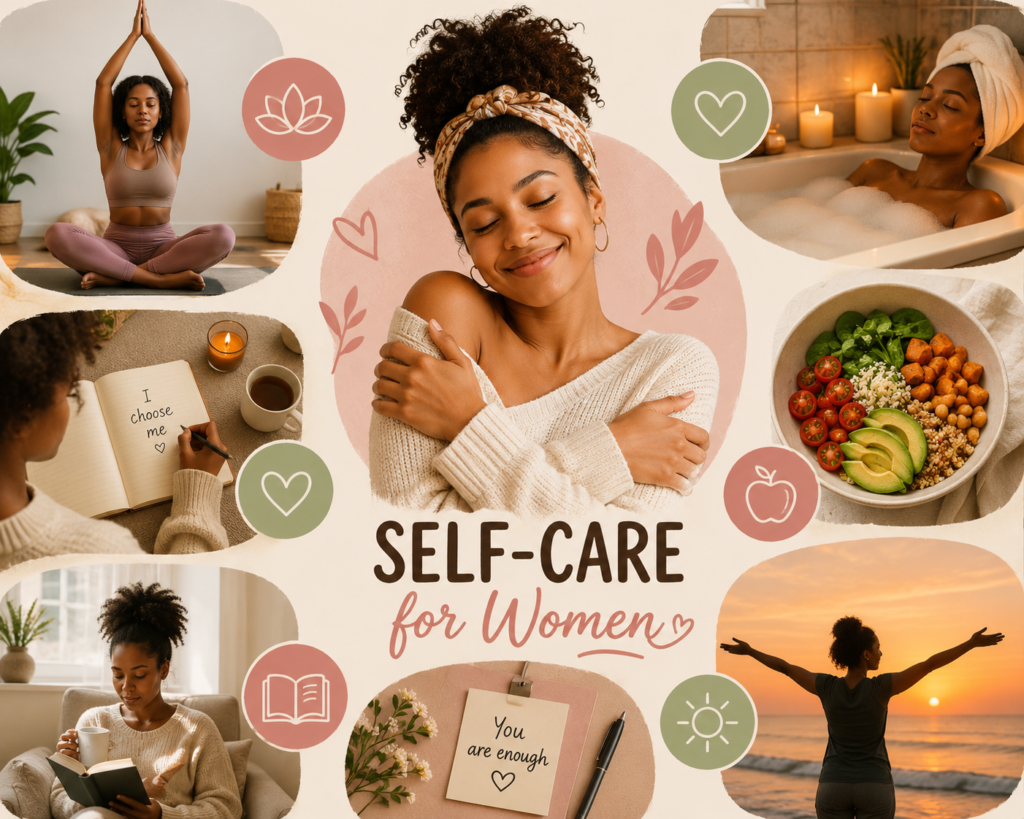
To build a sustainable, evidence-based wellness routine, we must look past the trends and break self-care down into its core clinical pillars: mental, physical, emotional, and boundary-driven.
The Ultimate Guide to Self-Care for Women 2026
1. Mental Self-Care: Rewiring Your Neurochemistry and Inner Narrative
Mental self-care focuses on cultivating a healthy cognitive environment. From a health perspective, this involves managing your chronic stress triggers, lowering daily cortisol production, and actively mitigating the cognitive fatigue caused by constant multitasking.
Mental Health Tip: Replace the “always-on” productivity mindset with structured “Cognitive Decompression Zones”—dedicated, tech-free windows of time where your brain is entirely liberated from logistics, planning, and executive decision-making.
Most women are plagued by a perpetual internal checklist. Even during moments of physical rest, the brain’s prefrontal cortex is quietly calculating grocery lists, work deadlines, or family schedules. This continuous cognitive load keeps the sympathetic nervous system on low-grade alert, raising your heart rate and keeping stress hormones elevated.
To practice effective mental self-care, you must introduce external cognitive offloading, often called “brain dumps.” Grab a piece of paper and write down every single thought, task, and anxiety swirling in your head until your mind feels clear. Neuropsychological studies show that once tasks are externalized onto paper, the brain ceases to dedicate working memory to maintaining them, instantly lowering subconscious anxiety.
Additionally, pay close attention to your internal dialogue. Neuroplasticity proves that the thoughts you repeat rewrite your neural pathways. If you wouldn’t speak to a close friend or a child the way you speak to yourself after making a mistake, your internal narrative requires an immediate boundary. Shift from harsh self-criticism to neutral, objective curiosity to protect your mental health from unnecessary psychological stress.
2. Physical Self-Care: Honoring the Female Infradian Rhythm
Your mind and body do not operate in silos; they are deeply interconnected through the endocrine and nervous systems. Physical self-care is not about meeting societal beauty standards or pushing your body to its absolute limits at the gym; it is about supporting your unique biological baseline.
Physical Health Tip: Track and schedule your high-intensity movement, sleep needs, and dietary intake according to your infradian rhythm (your monthly hormonal cycle) rather than trying to force an identical, high-energy output every single day.
The traditional 24-hour fitness and productivity cycle was largely studied, optimized, and built around male hormonal biology. Women of reproductive age, however, operate on a broader 28-day infradian rhythm that governs metabolism, stress response, sleep architecture, and brain chemistry. Forcing yourself to engage in high-intensity interval training (HIIT) or a strict caloric deficit when your body is in its late luteal or menstrual phase can spike your cortisol levels, disrupt your thyroid, and leave you exhausted rather than energized.
True physical self-care means matching your activity to your current biological state:
- Follicular & Ovulatory Phases: Estrogen and testosterone peak. This is the optimal time to maximize higher energy with strength training, cardio, and social engagement.
- Luteal & Menstrual Phases: Progesterone rises and drops. Your metabolism slightly increases, but your physical endurance decreases. Pivot to restorative yoga, steady-state walking, deep stretching, and longer sleep windows.
Beyond movement, physical self-care requires strict sleep hygiene. Sleep is the ultimate neurological clean-up process, during which the brain flushes out metabolic waste via the glymphatic system. Prioritizing seven to eight hours of quality sleep by keeping your bedroom cool, dark, and screen-free does more for your metabolic health, mood regulation, and cellular repair than any wellness supplement ever could.
3. Emotional Self-Care: Processing Over Suppressing
Emotional self-care is the medical and psychological practice of acknowledging, validating, and moving through your feelings rather than burying them under a veneer of “toxic positivity” or forced strength.
Emotional Health Tip: Establish an “Emotional Sanctuary Ritual”—a safe, private 15-minute window to experience uncomfortable emotions fully without attempting to judge, fix, or intellectualize them.
Women are often socially conditioned to act as the emotional shock absorbers of their environments. We are taught to be pleasant, accommodating, and calm. Consequently, emotions like anger, grief, disappointment, and deep frustration are frequently suppressed because they feel inconvenient to others.
However, psychoneuroimmunology shows that suppressed emotions do not simply vanish; they manifest physically. Unprocessed emotional stress can show up as chronic tension, jaw clenching, gastrointestinal distress, and heightened systemic inflammation. Emotional self-care requires creating a safe, regular outlet for somatic expression.
Learning to sit with discomfort is a foundational emotional skill. When a wave of anxiety or sadness hits, instead of immediately reaching for your phone to numb out or distract your brain, take slow, diaphragmatic breaths. Notice where the emotion lives in your body—is it a tightness in your chest? A knot in your stomach?
Sit with that physical sensation for just 90 seconds. Dr. Jill Bolte Taylor’s neuroanatomical research shows that the physical lifespan of an emotional cascade passing through the blood and body is roughly 90 seconds; it only lasts longer if we consciously feed it with repetitive, looping thoughts.
4. Boundary-Driven Self-Care: The Preventive Medicine of a Radical “No”
The most frequently overlooked aspect of preventive healthcare is protection. You can optimize your nutrition, take your supplements, and drink all the water you want, but if you let external demands continually violate your boundaries, your body will remain in a state of perpetual physiological stress.
Boundary Tip: Treat your time and metabolic energy as a finite healthcare budget. Every time you say “yes” to a low-priority external request that you lack the capacity for, you are actively choosing to bankrupt your personal health.
Practice saying “no” without providing a lengthy, defensive justification or an apology for your limitations. A simple, clear statement is completely sufficient:
- “I don’t have the capacity to take that project on right now, but thank you for thinking of me.”
- “I’m resting this evening, so I won’t be able to make it.”
You do not need to be physically ill or entirely broken down to earn the right to say no; simply wanting to preserve your nervous system’s health is a completely valid medical reason.
This also applies to your digital consumption. If scrolling through social media leaves your nervous system in a state of comparison, anxiety, or hyper-arousal, that platform is actively taking a toll on your health. Use app timers, curate your feed to only follow accounts that educate or inspire you, and implement a strict “no screens in bed” rule to protect the final hours of your circadian rhythm.
5. Environmental Self-Care: Engineering a Low-Cortisol Living Space
Environmental self-care is the practice of auditing and optimizing your immediate surroundings to lower subconscious stress. Your nervous system is constantly scanning your environment for threats, clutter, and sensory overload. If your home or workspace is chaotic, your brain interprets that chaos as an unfinished task, preventing true physiological relaxation.
Environmental Tip: Implement a “Sensory Low-Stimulation Zone” in your home—a designated space entirely free from clutter, bright artificial light, laundry piles, and work materials. Use this space exclusively for nervous system regulation.
The visual cortex requires significant brainpower to process busy surroundings. When you walk into a room filled with piles of paper, unwashed clothes, and scattered items, your brain triggers a micro-stress response. Studies in environmental psychology show a direct correlation between high home clutter scores and elevated levels of diurnal cortisol in women.
To practice environmental self-care, focus on sensory down-regulation. Our modern environments are hyper-stimulating, filled with fluorescent lights, buzzing appliances, and constant notifications.
As evening approaches, mimic the natural setting of the sun by turning off harsh overhead lights and relying on warm lamps or candlelight. This simple shift signals your pineal gland to begin synthesizing melatonin, preparing your body for deep, restorative sleep. Additionally, bring nature indoors. Keeping indoor plants or using essential oil diffusers with calming scents like lavender, cedarwood, or bergamot can measurably lower blood pressure and sympathetic nervous system activity.
6. Financial Self-Care: Mitigating the Stress of Economic Anxiety
Financial self-care is one of the most critical, yet least talked about, pillars of holistic women’s wellness. Money stress is not just a logistical problem; it is a profound mental health trigger that can lead to chronic sleep disturbances, anxiety, and a persistent feeling of instability.
Financial Health Tip: Shift from financial avoidance to a “Money Date”—a recurring, monthly 30-minute block of time where you review your accounts with zero judgment, solely to gain clarity and control over your resources.
For many women, financial anxiety leads to avoidance behavior: ignoring bank statements, putting off budgeting, or overspending as a temporary emotional coping mechanism. This avoidance creates a background hum of dread that saps your daily energy. Financial self-care means facing your numbers directly to strip away their power to intimidate you.
Start by automating your savings, even if the amount is small. Knowing you have an emergency fund—often referred to in wellness circles as a “peace of mind fund”—creates a psychological safety net that immediately lowers daily survival anxiety.
Furthermore, practice mindful consumption. Before making a purchase, pause and ask yourself if the item is fulfilling a genuine physical need or if it is an attempt to soothe an emotional deficit, such as exhaustion or loneliness. Aligning your spending with your actual values, rather than your temporary impulses, is a powerful act of long-term self-preservation.
7. Social Self-Care: Cultivating True Relational Nutrition
Social self-care is the intentional curation of your relational network. Human beings are neurobiologically wired for connection, but not all connections are created equal. As a woman, you likely default to playing the role of the nurturer, which can leave you surrounded by relationships that drain your energy rather than replenish it.
Social Health Tip: Categorize your relationships into “Relational Raditors” (those who radiate energy, support, and warmth) and “Relational Drains” (those who consistently consume your emotional energy without reciprocation). Maximize time with the former.
Loneliness and isolation are devastating to physical health, carrying a mortality risk comparable to smoking. However, being surrounded by the wrong kind of social interaction—unsupportive, hyper-critical, or emotionally parasitic relationships—spikes systemic inflammation and weakens your immune response.
Social self-care requires you to take a hard, objective look at your social circle. It means acknowledging that you cannot be everyone’s unpaid therapist. Permit yourself to naturally let superficial or toxic friendships fade.
Instead, invest your limited social energy into reciprocal relationships where you feel safe to let your guard down, express vulnerability, and be fully seen without having to perform or caretake. A single 20-minute deep conversation with a true, supportive friend can trigger a massive release of oxytocin, the hormone responsible for counteracting the damaging cardiovascular effects of chronic stress.
The Master 7-Pillar Self-Care Checklist
To seamlessly blend these advanced pillars into your existing wellness routine, use this comprehensive, expanded reference guide to monitor your health choices over the coming month.
[ ] MENTAL:     Have I done a 5-minute brain dump to clear cognitive clutter this week?
[ ] PHYSICAL:   Am I aligning my workout intensity with my current hormonal cycle phase?
[ ] EMOTIONAL:  Did I allow myself to sit with an uncomfortable feeling for 90 seconds today?
[ ] BOUNDARY:   Have I said an un-apologetic "no" to a request that exceeds my capacity?
[ ] ENVIRON:    Is my bedroom optimized for melatonin production with dim, warm lighting?
[ ] FINANCIAL:  Have I checked my accounts this month to maintain clarity over my budget?
[ ] SOCIAL:     Did I spend time or connect with someone who leaves me feeling energized?
The Lifelong Practice of Body Literacy
At its core, radical self-care for women requires building deep body literacy—the skill of listening to the subtle, early warning signs your body sends before they escalate into medical crises. A headache, chronic digestive issues, erratic sleep patterns, and sudden irritability are not inconveniences to be medicated away and ignored; they are your body’s check-engine lights.
By honoring these seven pillars, you choose to stop treating your body like a machine to be driven to exhaustion. You acknowledge that your health is your most valuable asset. Step away from the superficial, commercialized version of wellness and step into a deeply rooted, protective, and evidence-based lifestyle. You deserve the same care, dedication, and love that you so freely give to the rest of the world.
The Personalized Wellness Matrix
To make self-care functional and realistic, let’s look at how micro-habits across different timelines can accumulate into a transformative health routine. You do not need to overhaul your entire life overnight; pick just one small habit from this grid to integrate this week.
| Wellness Dimension | Daily Micro-Habit | Weekly Routine | Monthly / Seasonal Reset |
| Mental Health | 5-minute morning brain dump before opening email or social apps. | 1 hour of completely unstructured, tech-free hobby time to induce a “flow state.” | A full weekend digital detox to recalibrate dopamine receptors and improve focus. |
| Physical Health | Hydrating with structured electrolytes before consuming morning caffeine. | Structuring your workouts and rest days based on your current cycle phase. | Scheduling a clinical massage, acupuncture session, or a dedicated day of total rest. |
| Emotional Health | Pausing to name 3 distinct feelings throughout the day to practice emotional literacy. | A deep-dive somatic journaling session or a check-in with a licensed therapist. | Re-evaluating your social circle and intentionally pulling back from draining dynamics. |
| Boundary Protection | Saying “no” to at least one low-priority task or minor request that drains you. | Turning off work notifications entirely from Friday evening to Monday morning. | Reviewing your calendar and time budget to identify and patch chronic “energy leaks.” |
Shifting from Reactive to Proactive Health
Ultimately, clinical self-care is about taking radical ownership of your health outcomes. It requires moving out of a purely reactive state—where you simply respond to everyone else’s emergencies at the expense of your own body—and stepping into a proactive, intentional state. Your physical, mental, and emotional needs must be treated with the same clinical urgency and respect as anyone else’s.
Start small. True physiological transformation doesn’t happen during an isolated, week-long annual spa vacation; it happens in the tiny, daily decisions to protect your peace, feed your body whole foods, move in alignment with your hormones, and speak to yourself with profound kindness. You cannot pour from an empty cup. Fill yours first, and let your family, career, and community benefit from the healthy overflow.